Owned brand: motion
Act I: Launch Reel
23.6 seconds of vertical video to launch a three-piece collection, built to carry a story and to survive being watched on mute in a feed.
Role: Art direction, story & edit · Storyboard, styleframes, camera, typography, sound · 2026
Boards first
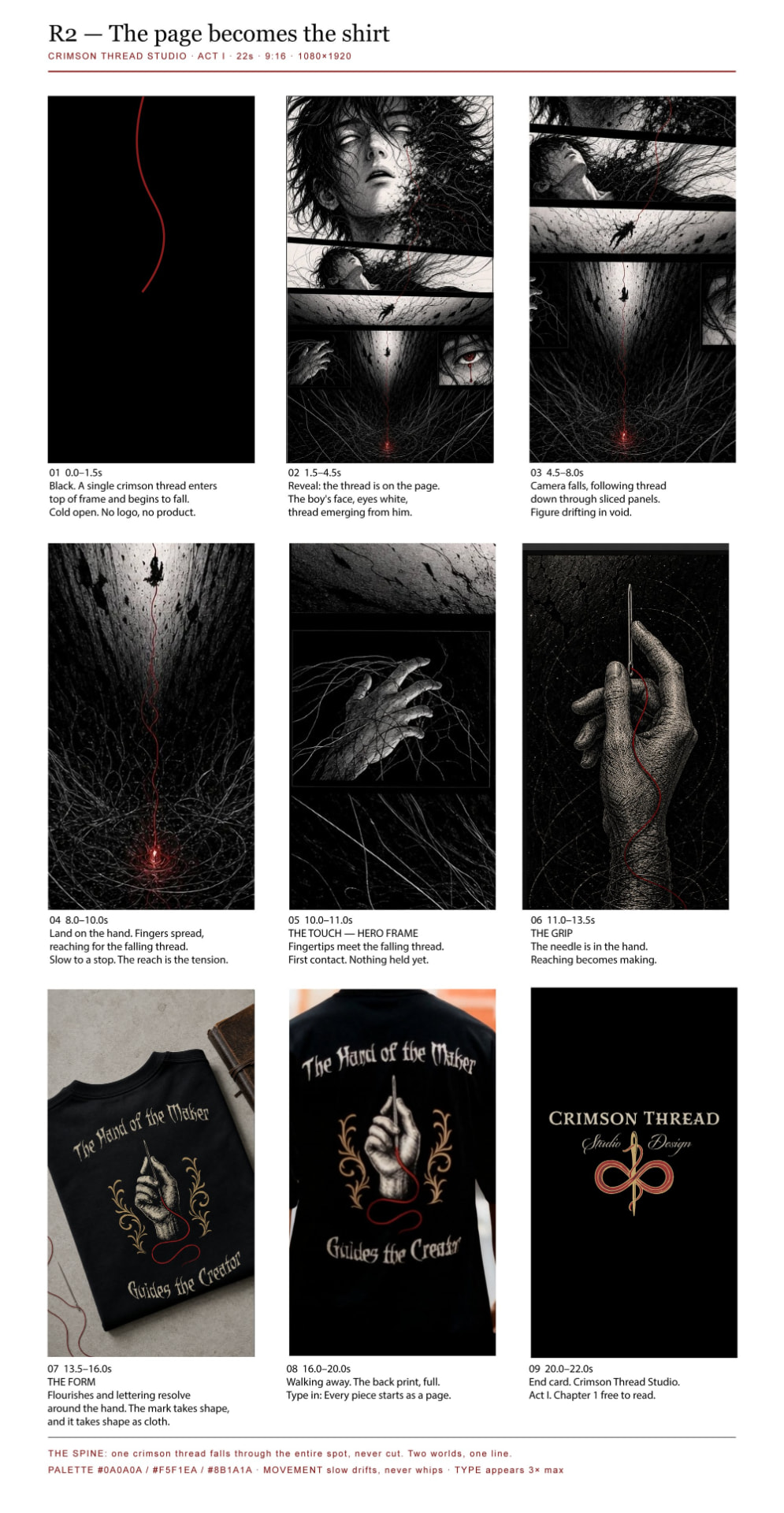
Nine frames, drawn and ordered before a single one moved. The board is where the story problems get solved. It is far cheaper to discover that a beat does not land as a still than to discover it in a finished cut.
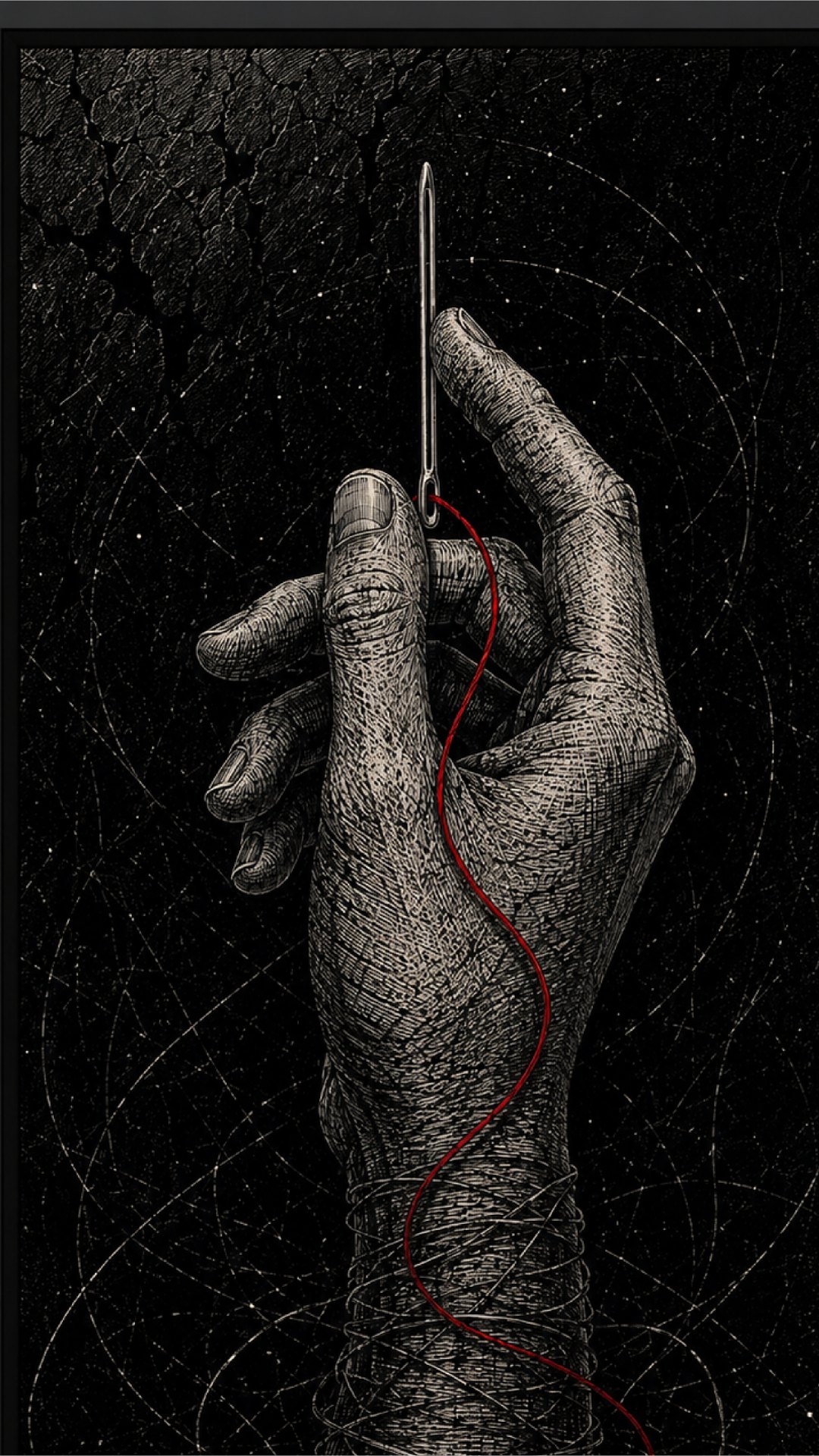
The hand appears twice. First reaching, drawn in manga line; then holding the needle, drawn as an engraving. Two different drawing languages, which is exactly what makes the cut between them read as a transformation rather than a dissolve.
The brief
Crimson Thread Studio sells apparel built on an original serialized manga. Each drop comes out of a specific chapter, so the problem was never "show the shirt." It was: make someone understand, in the length of a scroll, that the garment came from a story.
One constraint shaped everything. Most of this gets watched on mute, one thumb away from gone. So the reel had to work as a silent sequence of images first, with sound as an accompaniment rather than a crutch.
It runs 23.6 seconds, and that was a decision rather than a default. Vertical video under fifteen seconds completes at roughly 92%; this length band sits nearer 84%. I traded eight points of completion for a story that can actually be followed, on the reasoning that a piece nobody finishes and a piece nobody understands fail the same way. A fifteen-second cutdown for paid placement is a separate edit, not a compromise baked into this one.
The arc
Four sentences carry the whole piece: the object is worthless, something reaches for it, it becomes the maker's mark, it enters the world.
What changed
Nine boarded frames became six shots. The board above is the plan, not the reel. I've left it as drawn rather than back-dating it, because the gap between the two is the actual work.
The product shot came out
Board 07 was the folded garment on concrete, two and a half seconds of it. In the cut it stopped the reel dead. The story had just resolved into the maker's mark and then paused to photograph merchandise. The piece is 23.6 seconds long. There is no room for a beat that only sells.
The thread stopped being the spine
The original note on the board reads "one crimson thread falls through the entire spot, never cut." It was the best idea in the plan and it was wrong. Once the printed thread appears on the garment, a second drawn thread over the top competes with the product instead of pointing at it. It now leads for the first ten seconds, hands off, and leaves.
Three boards became one move
Frames 02, 03 and 04 were boarded as separate shots down the page. Cutting between them broke the fall. They became a single continuous camera move, which is the thing the whole first half rests on.
The walk-away was rebuilt
Board 08 called for a figure walking away down an alley. Generated, the gait was uncanny and he never actually receded. The constraint underneath: to read someone receding you have to show the body, and to hide a bad gait you have to crop tight. Those fight. So the figure stands still, cropped at the hips, and the recede is done in code instead.
The last line got rewritten
"Every piece starts as a page" became "Every piece comes from the page." Starts as implies the page was a stage the product left behind. Comes from keeps the story present tense in the object, which is the entire premise of the brand.
Three things I could measure
Because the reel is built in code, I could check things instead of guessing. Three that mattered.
The match cut
The hands had to line up
The two hands had to land on each other exactly. Doing it by eye kept failing, because the starfield behind them pulled my center point off. So I found each hand by the weight of its bright pixels instead. The second shot comes in at 1.547 times scale, lands with no offset, and pushes through.
The camera
The camera kept stalling
I eased each leg of the move on its own, which dropped the speed to zero every time it hit a keyframe. Three dead stops. A smoother curve fixed the stalls but sailed 138px past the final framing, so the shot bounced. The curve I landed on stays smooth and cannot overshoot.
The call to action
Nobody could read the domain
The domain on the end card came in at 2.8:1 against the background. That is below the floor for large text, and the top of it sat 15px inside the strip where every app stacks its own captions and buttons. The one line a person has to read and type was the line most likely to get covered up. I rebuilt the stack from the safe zone up. It reads at 8.3:1 now.
The sound
One bed of air runs under the whole reel. No music, no voice, and nothing that hits on a cut.
The no-hits part is the decision. Most reels put a sound on the edit so something tells you when to feel something. This one deliberately does not. The bed moves 4.7 LU from its quietest point to its loudest, which is close to flat, and it sits about six decibels under the reel itself. Nothing in it marks a moment.
What that buys is a space to arrive in. The reel is asking someone to slow down and read a manga page in the middle of a feed, and that is a different gear from the one they scrolled in with. The air gives them a second to change gears before the first line appears. On mute it costs nothing, because the images were built to carry it alone.
Delivery
The render came out flagged full-range with unspecified color primaries. Players and platform transcoders that ignore that flag assume a narrower range, which crushes everything below 16 and clips everything above 235, which is the precise failure mode for a piece built almost entirely out of near-black gradient with one bright highlight in it. The delivery master is converted to limited range and tagged bt709.
Audio came off the render 16 dB under the platform target, which would have handed Instagram's normalizer the job of raising it, along with the noise floor underneath. It ships at −20.5 LUFS, true peak −9.
Typography sits inside a 900×1400 safe zone with a 300px bottom dead strip, so nothing that matters gets covered on any of the three platforms it runs on.
What it has to do
The reel is top-of-funnel for a brand whose product only makes sense once you know there's a story behind it. It is not trying to sell a shirt in 23.6 seconds. It is trying to get one person to read Chapter 1, which is free, and which is where the actual conversion happens.
That is why the end card gives a chapter title and a domain rather than a product or a discount, and why the last thing on screen is the only line anyone can act on. Links aren't clickable in-feed on any of the three platforms this runs on, so the domain has to be legible enough to read and type from memory. Getting that line from a 2.8:1 contrast ratio to 8.3:1 was the single highest-leverage fix in the piece.
The result
The reel
23.6s · 1080×1920 · sound on, but it works without
How it was made
Art direction, story, storyboard, edit and sound by me. Built programmatically in React and Remotion, which is why the camera moves and transitions could be measured and tuned rather than keyframed by hand. The artwork is AI-generated and directed frame by frame; the brand, the logo and the garment graphics are my own design work.
Previous project
← Crimson Thread StudioNext project
Meridian Deck System →